

Governed Action Runtime for AI Coding Agents
Every tool call your AI agent makes — file writes, shell commands, git operations — passes through a deterministic governance kernel. 21 safety invariants. 87 destructive patterns. Full audit trail.
What AgentGuard Prevents
Real scenarios blocked by the governance kernel. No configuration required.
The Problem
- AI agents execute file writes, shell commands, and git operations with no governance layer
- One bad tool call can push to main, leak secrets, or delete production files
- No audit trail means no way to understand what happened or why
- Traditional AI safety focuses on model behavior, not execution-layer enforcement
The Solution
- Deterministic decision point between proposal and execution
- YAML policies declare what agents can and cannot do — version-controlled boundaries
- 21 built-in invariants + 87 destructive patterns detected automatically
- Pre-execution simulation predicts impact before anything runs
Built for Safety at Scale
Everything you need to govern AI agent actions in development, CI, and production environments.
21 Safety Invariants
Secret detection, credential protection, branch guards, blast radius limits, lockfile integrity, script injection, CI/CD protection, network egress control, governance self-modification prevention. Always on.
87 Destructive Patterns
rm -rf, sudo, docker prune, DROP TABLE, pkill, systemctl—detected and classified by the AAB before execution.
Deterministic Kernel
Same action + same policy = same decision. Every time. No probabilistic surprises.
Impact Simulation
Filesystem, git, and package simulators predict blast radius and risk level before execution.
YAML Policies
Version-controlled boundaries. Compose multiple policies with precedence. 7 built-in policy packs.
Full Audit Trail
49 event kinds across JSONL or SQLite. Inspect, replay, export, diff, and attach evidence to PRs.
Escalation System
NORMAL → ELEVATED → HIGH → LOCKDOWN. Repeated violations trigger automatic lockdown.
RTK Token Optimization
Integrated with RTK for 60-90% token savings. Shell commands auto-rewrite to compact output after governance approval. Git, npm, cargo, docker, kubectl, and more.
Kernel Architecture
Every agent action passes through a governed pipeline. Seven stages, deterministic outcome.
The kernel is the single decision point. Same action + same policy = same outcome. No side channels, no probabilistic evaluation, no exceptions.
Action Authorization Boundary
The AAB normalizes raw tool calls into 23 canonical action types across 8 classes. Every agent operation—whether a Bash command, file write, or git push—gets classified before evaluation.
Simulation Engine
Three simulators (filesystem, git, package) predict impact before execution. High-risk simulations can flip ALLOW → DENY at runtime. Blast radius scored 0–100.
Escalation State Machine
Tracks denial and violation counts. Escalation levels persist as state-change events. In LOCKDOWN, all actions are denied until a human resets the state.
20 Built-in Invariants
Safety checks that run on every action. Zero configuration. Always on.
| Invariant | Severity | Description |
|---|---|---|
| no-secret-exposure | CRITICAL | Blocks access to .env, credentials, .pem, .key files |
| no-credential-file-creation | CRITICAL | Blocks creation of SSH keys, .netrc, cloud credentials, Docker config |
| protected-branch | HIGH | Prevents direct push to main/master |
| no-force-push | HIGH | Forbids force push that rewrites shared history |
| no-skill-modification | HIGH | Prevents modification of .claude/skills/ files |
| no-scheduled-task-mod | HIGH | Prevents modification of scheduled task files |
| no-package-script-injection | HIGH | Blocks package.json modifications that alter lifecycle script entries |
| blast-radius-limit | MEDIUM | Enforces file modification limit (default 20 files) |
| test-before-push | MEDIUM | Requires tests pass before git push |
| lockfile-integrity | LOW | Ensures package.json changes sync with lockfiles |
| no-cicd-config-modification | CRITICAL | Prevents modification of CI/CD pipeline configurations |
| no-governance-self-modification | CRITICAL | Prevents agents from modifying governance config and policy files |
| no-permission-escalation | HIGH | Blocks filesystem permission escalation (setuid, sudoers, ownership) |
| transitive-effect-analysis | HIGH | Detects scripts whose contents would be denied if executed directly |
| no-network-egress | HIGH | Denies HTTP requests to non-allowlisted domains |
| no-destructive-migration | MEDIUM | Flags migration files containing DROP, TRUNCATE, or destructive DDL |
| large-file-write | MEDIUM | Enforces file write size limits to prevent data dumps |
| no-container-config-modification | MEDIUM | Blocks modification of Dockerfile and container config files |
| no-env-var-modification | MEDIUM | Prevents modification of environment variables and shell profiles |
| recursive-operation-guard | LOW | Flags recursive operations combined with write/delete actions |
| no-ide-socket-access | HIGH | Blocks access to IDE socket files (vscode-ipc-*.sock) |
Quick Start
Three commands. That's it.
$ npm install -g @red-codes/agentguard# Homebrew (macOS/Linux) — 60-90% token savings
$ brew install rtk
# Windows: github.com/rtk-ai/rtk/releases$ agentguard claude-init$ agentguard statusNot Like Other Tools
AgentGuard operates at the execution layer — after the model decides what to do, before the action touches your system.
| Category | What they do | What AgentGuard does |
|---|---|---|
| LLM Guardrails | Filter model output text | Governs actual tool execution |
| Prompt Filters | Block unsafe prompts | Operates after the prompt, at execution time |
| Static Analysis | Scan code at rest | Intercepts actions in real-time |
| Git Hooks | Pre-commit / pre-push checks | Governs all agent actions, not just git |
| Policy-as-Code | Infrastructure policy (OPA, Sentinel) | Agent action policy with simulation |
Policy as Code
Define governance boundaries in YAML. Compose multiple policies with precedence. Drop them in your repo root.
# agentguard.yaml
id: default-policy
name: Default Safety Policy
severity: 4

rules:
  - action: git.push
    effect: deny
    branches: [main, master]
    reason: Direct push to protected branch

  - action: git.force-push
    effect: deny
    reason: Force push rewrites shared history

  - action: file.write
    effect: deny
    target: .env
    reason: Secrets files must not be modified

  - action: file.read
    effect: allow
    reason: Reading is always safe
Deny rules block dangerous actions
Prevent direct pushes to protected branches, force pushes, and secrets file modifications.
Allow rules grant explicit permission
Safe operations like file reads are explicitly allowed. Clear intent, no ambiguity.
Composable with precedence
Stack multiple policies: --policy base.yaml --policy team.yaml. Later policies take precedence.
7 built-in policy packs
Pre-built packs for common scenarios: ci-safe, enterprise, open-source, strict.
29 CLI Commands
Full lifecycle governance from your terminal.
Governance
- guard — Start governed runtime
- inspect — Action graph + decisions
- events — Raw event stream
- analytics — Violation patterns
- status — Governance session status
- audit-verify — Audit chain integrity
Replay & Debug
- session-viewer — Interactive HTML dashboard
- replay — Session timeline replay
- diff — Compare two sessions
- traces — Policy evaluation traces
- simulate — Impact prediction
Portability & CI
- export / import — Session portability
- ci-check — CI verification
- evidence-pr — PR evidence reports
- policy validate — Policy linting
- policy-verify — Structure verification
Plugins
- plugin list — Installed plugins
- plugin install — Add a plugin
- plugin remove — Remove a plugin
- plugin search — Search npm
Setup & Integration
- claude-init — Claude Code hooks
- copilot-init — GitHub Copilot hooks
- cloud connect — Connect to AgentGuard Cloud
- cloud events/runs — Query cloud data
- auto-setup — Auto-detect & configure
- config — Show/get/set config
- init — Scaffold extensions
- demo — Interactive showcase
Adoption & Migration
- adoption — Metrics & onboarding
- learn — Interactive tutorials
- migrate — Version migration
Claude Code Mapping
- Write/Edit → file.write
- Read → file.read
- Bash → shell.exec / git.*
- Glob/Grep → file.read
Agent Swarm
Deploy a coordinated team of governed AI agents. 26 agents across 5 tiers, each with dedicated skills, schedules, and governance policies.
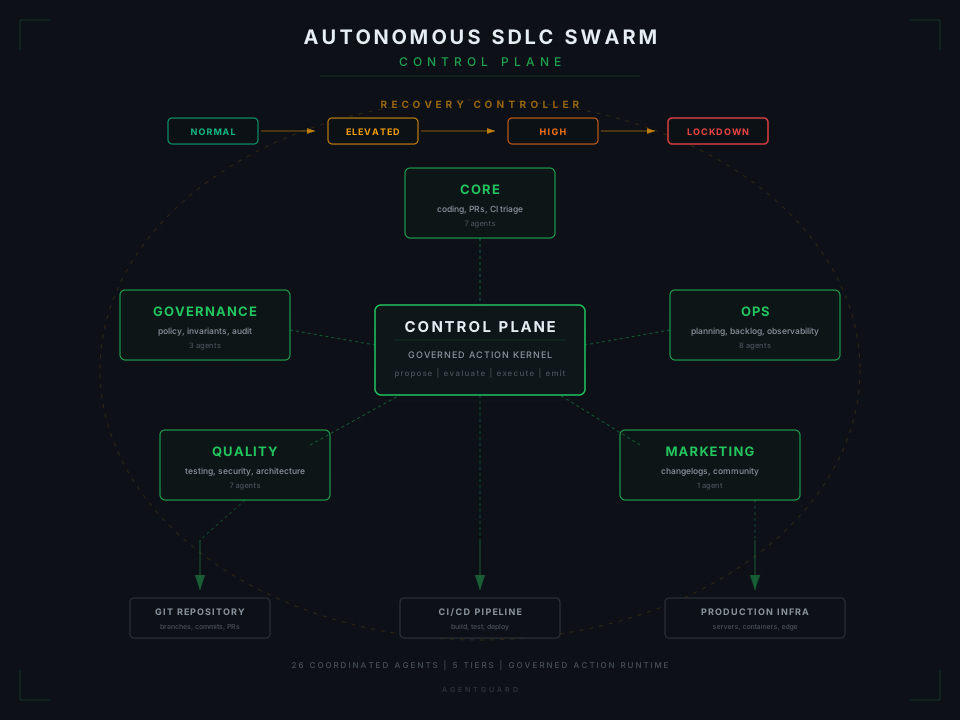
Core
7 agents- Implementation — Picks issues, codes, opens PRs
- Code Review — Reviews open PRs
- PR Merger — Auto-merges approved PRs
- CI Triage — Diagnoses failing CI
- Conflict Resolver — Fixes merge conflicts
- PR Responder — Addresses review comments
- Branch Janitor — Cleans stale branches
Governance
3 agents- Risk Escalation — Assesses cumulative risk
- Recovery Controller — Self-healing playbooks
- Governance Monitor — Audits governance logs
Ops
8 agents- Planning — Sprint planning from backlog
- Observability — Monitors runtime health
- Backlog Groomer — Triages stale issues
- Docs — Keeps docs in sync
- Product Health — Dependency & coverage checks
- Progress Controller — Tracks sprint velocity
- Repo Hygiene — Labels, templates, configs
- Retrospective — Weekly retrospectives
Quality
7 agents- Testing — Runs & expands test suites
- Test Generation — Generates new tests
- Security Audit — Scans for vulnerabilities
- Architecture Review — Detects drift & debt
- CI/CD Hardener — Strengthens pipelines
- PR Audit — Audits merged PRs
- Infra Health — Infrastructure checks
Marketing
1 agent- Content Agent — Changelogs, social posts & community engagement from project activity
Quick Start
Scaffold all tiers:
agentguard init swarmSelect specific tiers:
agentguard init swarm \
  --tiers core,governance
Install with npm install -g @red-codes/agentguard. Generates .claude/skills/, agent prompts, and agentguard-swarm.yaml config.
Post-Setup — Required
Scaffolding generates the files, but agents still need to be configured in Claude Desktop before they can run:
- Create scheduled tasks — Register each agent as a scheduled task in Claude Desktop using the cron schedules from the agent manifest.
- Set worktree: true — Enable worktree isolation so parallel agents get their own git worktree and don't conflict on file writes or git state.
- Bypass permissions manually — Agents run unattended with no human to approve prompts. Pre-approve the required tool permissions (file, shell, git) in Claude Desktop for each agent.
AgentGuard's governance policy + invariant system enforces safety boundaries even with permissions bypassed.
Integrations
Governance where your agents already work.
Claude Code
Inline hook integration — no daemon, no sidecar. Fires on every tool call, evaluates policies in-process, and exits. Fail-open by design.
$ agentguard claude-initGitHub Copilot
Same governance engine for Copilot CLI. Tool names normalized to canonical actions. All policies and invariants apply identically.
$ agentguard copilot-initVS Code Extension
Sidebar panels for run status and history. Inline diagnostics for invariant violations. Real-time governance notifications.
GitHub Actions
Reusable CI workflow for governance verification. Evidence packs attached to pull requests. Policy validation in your pipeline.
Audit-Ready by Design
Deterministic governance produces verifiable evidence. Every decision is recorded, queryable, and exportable.
JSONL + SQLite
Append-only audit trail with indexed queries. Portable JSONL export for CI and archival.
Deterministic Decisions
Same action + same policy = same decision. No probabilistic evaluation. Reproducible outcomes.
Evidence Packs on PRs
Attach governance evidence summaries to pull requests. Provable compliance in code review.
Policy Composition
Org-wide base + team overrides. 4 built-in packs: ci-safe, enterprise, open-source, strict.
Session Replay & Diff
Replay any governance session. Compare runs side-by-side. Forensic analysis built in.
Session Viewer
Interactive HTML dashboard with action timeline, escalation progression, and violation breakdown. Auto-opens when a Claude Code session ends. Shareable via --share.
Export & Portability
Export sessions as portable JSONL. Import across environments. CI-ready verification.
What’s Next
AgentGuard is evolving from advisory interception to mandatory execution control. Here’s the trajectory.
Rust Kernel — crates/kernel-core/
Native governance kernel in Rust for lower latency and smaller footprint. Early development — the TypeScript kernel remains the production implementation.
Phase 6 — Reference Monitor Hardening
Default-deny unknown actions. Enforce PAUSE and ROLLBACK intervention types. Close all bypass vectors.
Phase 7 — Capability-Scoped Sessions
Each governance run gets a bounded authority set via RunManifest. No capability, no effect.
Phase 9 — Multi-Agent Integrations
Framework adapters for LangGraph, CrewAI, AutoGen, OpenAI Agents SDK. Generic MCP adapter. Cursor integration.
Phase 13 — Environmental Enforcement
OS-level sandboxing via Bubblewrap and Seatbelt. Read-only mounts, network deny-by-default, credential stripping.
Phase 14 — Multi-Agent Governance
Agent identity verification, PID-bound capability tokens, cross-agent policy, fleet orchestration.
Phase 18 — Remote Governance Runtime
Server mode, centralized event ingestion, remote policy distribution, multi-repo governance, team dashboard.
Open Source
Apache 2.0 Licensed
AgentGuard is built in the open. Write invariants, create policy packs, build adapters, or contribute a renderer.